Anatomy of a photo: Balvenie Scotch

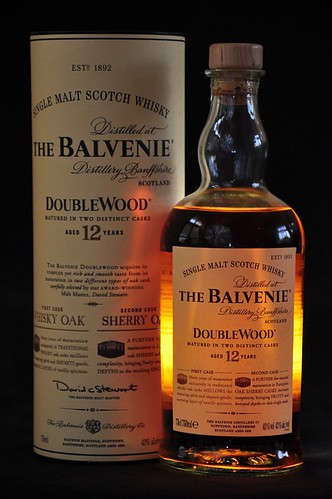
Several unconnected events converged to make this photo (below). First, I received a review copy of The Nikon Creative Lighting System by Mike Hagen (from rockynook and NikoniansPress publishing). A review is on the way. Second, and more importantly, I received as a gift a bottle of Balvenie Doublewood 12 year old single malt scotch.

Read on to get details of the lighting setup and what I think works and could be improved in this photo.

Balvenie Doublewood 12 Year Old

The setup

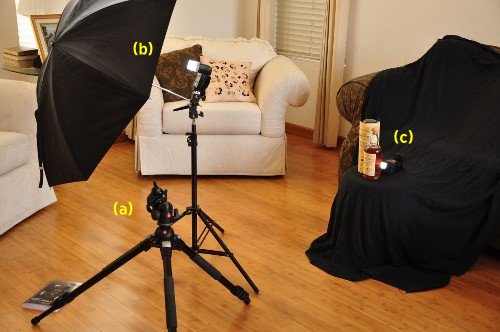
This scene was lit with two off-camera flashes. The first reflected from an umbrella directly to camera left set at -1.3 EV. The second directly behind the bottle, aimed at about a 45 degree up angle and towards the camera at 0 EV (TTL mode, normal sync). This flash was zoomed to 50mm. Both flashes were triggered wirelessly from the D90 built-in commander which did not contribute to the exposure. 98mm, 1/60s, f/5.6.

Flash setup

The good

Let’s talk about what I like in this photo and what I don’t like. First, the good. Overall, I got the effect I was going for. The scotch seems to radiate with a warm, inner light (which is just how it makes you feel). The tone is somewhat dark and moody as one would expect from a drink that’s so, you know, manly.

I intentionally used settings to blur the background container while still keeping all of the important text legible. I very much like the reflections of the whisky on the container. The background is dark and all of the attention is on the bottle. This photo (shot as a JPG fine) was cropped, resized, and sharpened slightly. No other image adjustments were made. It was the best of about 15 different takes.

The bad

FlawsFlaws are more interesting thought, aren’t they? For starters, the bottle isn’t full (a). I was willing to sacrifice a perfect photo for a dram or two. I guess that makes me a bad photographer. But I have no regrets.

I zoomed the flash behind the bottle to 50mm to help minimize light spill (b). You can still see some light reflecting off the bottle, lower right. This would be virtually impossible to completely eliminate without using a snoot for the flash but is easily removed in post-processing.

There’s even more light spill lighting up the side of the container behind the bottle. Whether this is a flaw or not is a matter of taste. Again, it could be eliminated with a snoot on the rear flash. This area would be more difficult to deal with in post.

I have a feeling that the photo would be better off without the window reflections on the bottle (d). Or perhaps, with cleaner reflections. Closing the curtains or moving to a different room without windows would have helped. It would be very difficult and time-consuming to cleanly remove the reflections on the neck in post so this is definitely a decision you want to make while shooting.

A little extra light on the tube container in the background (c) would have helped balance the photo a little better and added interest without taking away from the bottle. Maybe just a little rim lighting on the left side. Or maybe a dim spotlight thrown across “The Balvenie”…

What do you think? Any tips to share? What would you change about this photo?

Anatomy of a photo: The silly faces project

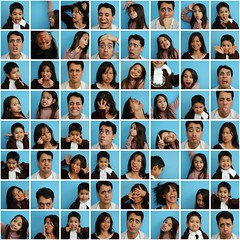
The silly faces projectI recently published this photo on Flickr (click here to view larger) and it received a lot of interest so I thought I’d share how I made it. Taking 64 photos like this may look like a lot of work but it can actually be done quite easily. Here’s how I did it.

First of all, I used two flashes for lighting. An on camera SB-800 with diffusion dome pointed up and back and an off-camera SB-600 bounced into an umbrella to the right of the camera. You can do this without fancy lighting equipment. The important thing to remember is simply that the lighting must be consistent from shot to shot.

Read more…

Take better flash photos in one easy step

Photo by *Micky
Photo by *Micky

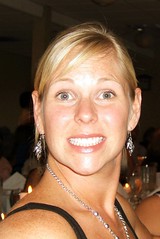
Many people shy away from flash photography because it makes people look bad. Photographs taken with a flash can leave harsh shadows that highlight every wrinkle, turn skin blue, shine a flood light at thinning hair, create hot spots on the forehead, nose and cheeks, and generally make subjects look unattractive. But when there isn’t enough light, sometimes your only choice is to use a flash or not take photos at all.

Well, I’m here to tell you that your flash photos indoors can look amazing. And here’s how…

Read more…

Photography and magic and Nikon CLS

A friend of mine calls me up every week or so with a photography question. Usually, he’s looking for the magic incantation or editing technique that will make his photos turn out in a particular way. Sometimes there is such a thing (e.g. wait for the the flash to charge, use manual focus, etc.). But usually there isn’t. Usually, getting a particular effect in a photograph, either at the camera or in post-production, requires experience, artistry, experimentation, and work. And a lot of the stuff you learn on one photo can’t just be applied blindly to the next one. School portraits aside (ha!), every photo is different.

Read more…

Workshop at the Ranch

Dave Black has a wonderful website. One of his monthly features is called Workshop at the Ranch. There he gives insightful tips on how to use off-camera flash in creative ways. Although anyone using wireless flash units can benefit from Dave’s experience, his series is of particular interest to Nikon shooters using SB-800s and the Nikon Creative Lighting System.

I make it a point to check back each month to learn more from this master of Nikon flash. I particularly like his method of using warm gels with SB-800 Speedlights to create warm subject lighting and a cool blue background. I think it works particularly well for sports portraits, but I’ve used it for a variety of subjects.

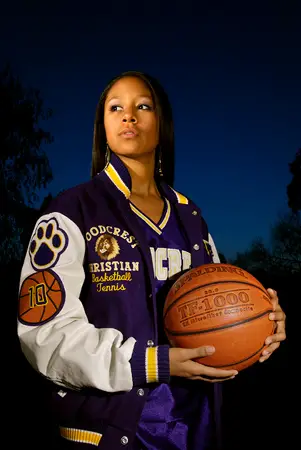
Alicia with Basketball

This is an example using Dave’s technique for a Senior Portrait.

Read more…

Page 1 of 3123